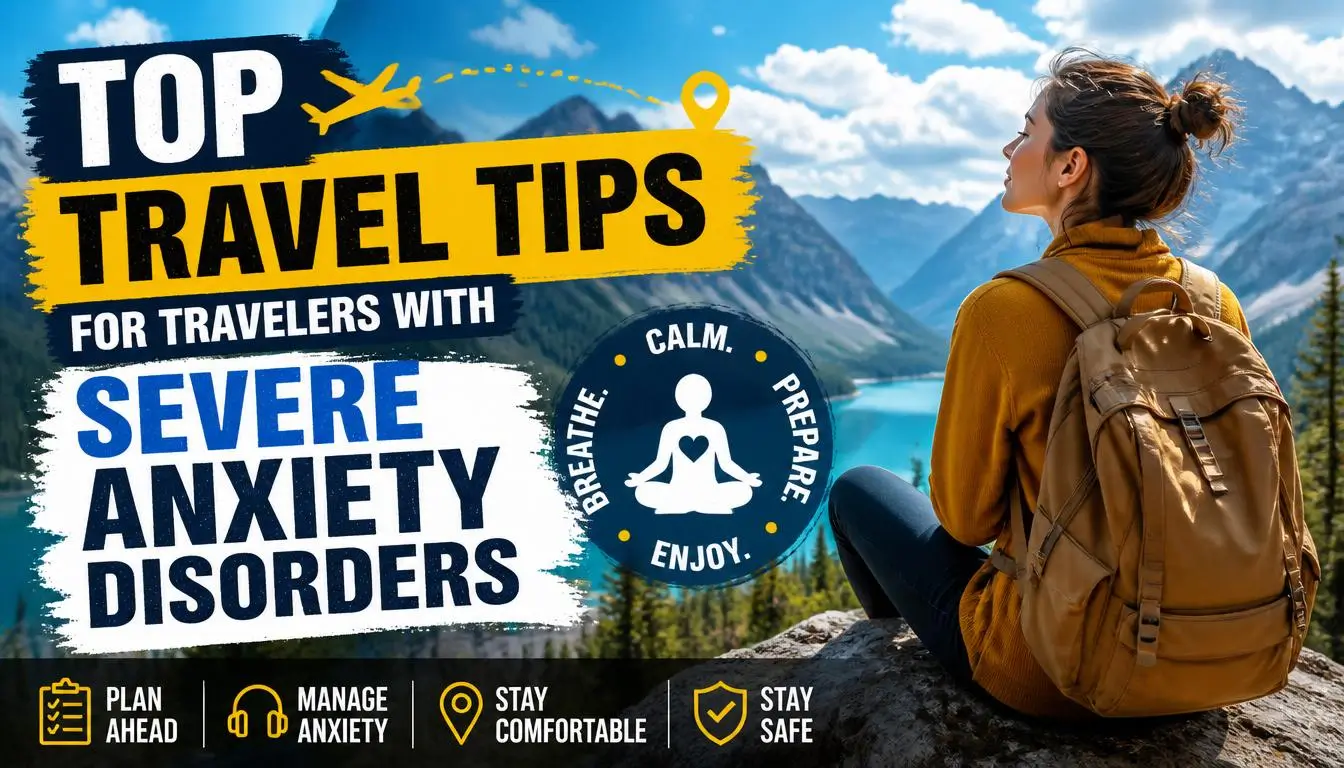
Finding travel tips for travelers with severe anxiety disorders that go beyond “just breathe and think positive” is harder than it should be, and frankly most of what exists online reads like it was written by someone who has never experienced anxiety beyond mild pre-flight nervousness. Severe anxiety disorders are not fixed by a breathing exercise and a positive attitude. They involve real physiological responses, genuine cognitive distortions, and sometimes years of avoidance behavior that has quietly shrunk the world down to a manageable but suffocating size. I’ve lived this. I’ve also traveled through it, imperfectly and sometimes painfully, and what follows is what actually helped.
Understand the Difference Between Anxiety About Travel and Anxiety Disorder
This distinction matters more than most travel advice acknowledges, and collapsing it produces advice that is useless at best and genuinely harmful at worst.
Almost everyone feels some pre-travel nervousness. The logistics, the unknown, the disruption to routine, these produce mild anxiety in most people and resolve quickly once the trip begins. Severe anxiety disorders produce something categorically different. Generalized anxiety disorder, panic disorder, agoraphobia, OCD, and PTSD all interact with travel in specific and distinct ways that require specific and distinct responses. Someone with panic disorder fears the panic attack itself and the inability to escape a triggering situation, which makes confined spaces like planes and trains particularly difficult. Someone with OCD may struggle with contamination fears that make hotel rooms and shared transport genuinely distressing in ways that can’t be reasoned away. Someone with agoraphobia may find any unfamiliar environment threatening regardless of objective safety. Knowing which specific anxiety profile you’re working with determines which strategies are actually relevant to your situation and which are just well-meaning noise.
1. Work With Your Mental Health Provider Before Planning Anything
This is the step that separates travel that builds confidence from travel that reinforces avoidance patterns, and it belongs at the beginning of every trip planning process for severe anxiety sufferers.
Your therapist, psychiatrist, or psychologist needs to know you’re planning to travel before you book anything. Not as a permission-seeking exercise but as a collaborative planning conversation. A therapist trained in Cognitive Behavioral Therapy or Exposure and Response Prevention can help you identify which aspects of the trip are likely to trigger your specific anxiety patterns and build a graduated exposure plan that approaches them intentionally rather than accidentally. Your psychiatrist needs to know about travel plans to assess whether your current medication is optimally adjusted for the stress of travel, whether a short-term prescription for acute anxiety management during transit makes sense for your situation, and whether your medication requires any adjustment for significant time zone changes. Getting this conversation wrong, or skipping it entirely, is how well-intentioned travel attempts become traumatic experiences that make future travel harder rather than easier.
2. Start Smaller Than Your Ambition Wants You To
Every severe anxiety sufferer I know, including myself, has made the same mistake at least once: deciding that the way to beat travel anxiety is to go big. Book the international trip. Do the thing that scares you most. Exposure therapy works, so maximum exposure must work best.
This is a fundamental misunderstanding of how graduated exposure actually functions. Exposure therapy works by presenting anxiety-triggering situations at a level that produces manageable distress, allowing the nervous system to learn that the feared outcome doesn’t materialize, and then gradually increasing the challenge as tolerance builds. Jumping straight to maximum challenge without building the foundation produces overwhelm rather than learning, and overwhelm reinforces avoidance rather than overcoming it. Start with a one-night trip within driving distance of home. Stay somewhere you’ve never stayed but in a town that feels manageable. Then a two-night trip slightly further. Then a flight to a domestic destination. Build the evidence base that travel is survivable before attempting the trip that lives in your imagination as the ultimate goal. The evidence base is what your anxious brain actually needs, not the inspirational story of someone who jumped in the deep end and was fine.
3. Build a Detailed Safety Plan Before Every Trip
A safety plan for travel with severe anxiety is not the same as a packing list or an itinerary. It is a specific document that addresses what you will do if your anxiety escalates beyond what you can manage independently during the trip.
Your safety plan should include the contact information of your therapist and psychiatrist with their after-hours or emergency contact options if available. It should include the name and dose of any PRN medication you carry for acute anxiety and the specific circumstances under which you’ve agreed with your provider to use it. It should include the address of the nearest hospital or urgent care facility at your destination. It should include the name and phone number of one person at home who knows your travel plans and is available to receive a call if you need grounding support. It should include two or three specific grounding techniques that your therapist has confirmed work for your particular anxiety profile. Keep this document on your phone as a note and in a small printed card in your wallet. Knowing it exists reduces anticipatory anxiety significantly because your brain stops running the “but what if something goes wrong” loop when there’s an actual answer to that question.
4. Choose Destinations That Reduce Environmental Anxiety Triggers
Destination choice for severe anxiety sufferers involves considerations that don’t appear on any standard travel guide’s radar, and getting this wrong turns a trip into an endurance test rather than an experience.
Crowds, noise, unfamiliar languages, unpredictable transport systems, extreme heat, and high-stimulus environments all represent potential anxiety amplifiers depending on your specific profile. For most severe anxiety sufferers starting to rebuild a travel life, smaller cities and towns serve better than major metropolitan areas. A week in the English countryside, a few days in a small Portuguese town, a cabin rental in a national park, these environments offer novelty and genuine travel experience without the sensory overload of navigating Tokyo or New York in your first few anxious trips. As your tolerance and confidence build, more complex destinations become genuinely manageable. But starting in an environment that matches your current nervous system capacity rather than your aspirational capacity produces success experiences rather than survival experiences, and success experiences are the actual building blocks of lasting travel confidence.
5. Plan Your Days With Scheduled Rest and Exit Options
Anxiety feeds on helplessness, and helplessness in travel often comes from feeling trapped in situations with no clear exit. Building exits into your plans is not pessimism. It is smart nervous system management.
Every planned activity on an anxiety-managed trip should have a clear and easy exit option that you’ve identified in advance. The museum has benches near the exit where you can sit if you need to step out. The restaurant is within walking distance of the hotel. The tour allows drop-off at any point. You have the hotel address saved in your phone and rideshare apps downloaded and working before you need them. Beyond exits, build genuine rest blocks into each day, not just lunch breaks but actual scheduled time in your accommodation where you’re allowed to do nothing, decompress, and let your nervous system recover from the stimulation of being somewhere unfamiliar. Trying to push through anxiety symptoms to maximize sightseeing is a strategy that works for roughly one day before it stops working entirely and leaves you in your hotel room for two days recovering from what a rest block would have prevented.
6. Manage the Airport and Transit Experience Specifically
Airports and transit hubs are among the most consistently difficult environments for severe anxiety sufferers because they combine crowds, noise, time pressure, loss of control, and confined spaces into a single sustained experience that can last hours.
Arrive at airports earlier than any standard recommendation suggests. Not the standard two hours for domestic or three hours for international. Arrive four hours early if your anxiety profile includes significant transit anxiety. The extra time eliminates the time pressure component entirely, which removes one of the most powerful anxiety amplifiers from the equation. Use airline apps to check in, select seats, and access boarding passes before you arrive so the airport experience requires as little active navigation as possible. Airport lounges, accessible through a Priority Pass membership, through certain credit cards, or through a day pass purchase, offer a quieter, lower-stimulus environment with food and seating that makes the waiting period dramatically more manageable. TSA PreCheck in the U.S. and its equivalents internationally significantly reduce the security experience stress by removing the need to unpack bags, remove shoes, and navigate the most chaotic part of the airport experience in real time.
7. Carry a Carefully Assembled Anxiety Management Kit
The physical kit you carry for anxiety management during travel should be assembled in advance with your therapist’s input rather than grabbed impulsively from a pharmacy shelf the day before departure.
What goes in it depends on your specific profile, but a well-assembled kit typically includes:
- Any PRN medication prescribed by your psychiatrist for acute anxiety episodes
- A printed copy of your safety plan and grounding techniques
- Noise-canceling headphones, the Sony WH-1000XM5 or Bose QuietComfort 45 genuinely reduce environmental anxiety triggers in loud transit environments
- A comfort item that has genuine personal grounding significance, not because it’s magic but because familiar objects reduce the perceived threat level of unfamiliar environments
- A fidget tool or tactile grounding object for acute anxiety moments
- A downloaded playlist of music, audiobooks, or podcasts that your nervous system associates with calm rather than stimulation
- Snacks that don’t require refrigeration because hunger destabilizes blood sugar and significantly worsens anxiety symptoms in ways that feel indistinguishable from anxiety escalation to a sensitized nervous system
8. Use Technology as a Genuine Support Tool
The right technology used deliberately reduces several categories of anxiety that would otherwise require significant mental energy to manage during travel.
Google Maps offline downloads for your destination eliminate navigation anxiety by making directions available even without data service. Download them before you leave home. Rome2Rio maps transit options between any two points globally and removes the anxiety of figuring out unfamiliar transport systems on the fly. Calm and Headspace both have travel-specific content including sleep meditations for unfamiliar hotel rooms and anxiety management exercises formatted for use in transit. iTranslate and Google Translate with offline language packs reduce the anxiety of unfamiliar language environments by making basic communication manageable without data. WhatsApp keeps you connected to your home support network internationally without expensive international calling plans. None of these tools replaces the therapeutic work of managing anxiety. They reduce the cognitive load of travel logistics, which frees mental capacity for the anxiety management work itself.
9. Communicate Your Needs Without Apologizing for Them
Severe anxiety sufferers frequently under-communicate their needs during travel out of embarrassment, a desire not to be seen as difficult, or a habitual minimization of their own experience that anxiety disorders frequently produce.
Telling a flight attendant you have severe anxiety and asking them to let you know if there’s anything unusual about turbulence before it happens is a completely reasonable request. Telling a hotel front desk that you have a medical condition that benefits from a quiet room away from elevators and ice machines is a completely reasonable request. Telling a tour guide that you may need to step out briefly and asking where the nearest quiet area is before the tour begins is a completely reasonable request. You are not asking for special treatment. You are communicating a genuine health need in a way that allows other people to support you effectively. The vast majority of hospitality and transport professionals respond with more warmth and helpfulness than severe anxiety sufferers typically predict, because the anxious brain systematically overestimates the negative social consequences of self-advocacy.
10. Debrief Every Trip Honestly With Your Therapist
Every trip taken with severe anxiety, regardless of how it went, contains information that is genuinely useful for future travel if it’s processed intentionally rather than just survived and then avoided thinking about.
What triggered your anxiety more than expected. What triggered it less. Which coping strategies worked in real conditions and which ones that work in your therapist’s office didn’t transfer to an airport. What would you tell yourself before the next trip that you didn’t know before this one. Which parts of the trip were genuinely enjoyable despite the anxiety being present, because for most anxiety sufferers enjoyment and anxiety coexist more often than the disorder’s narrative suggests. Bringing this debrief to your therapist rather than processing it alone means someone with clinical training helps you extract accurate information from the experience rather than the distorted version your anxiety will offer if left to narrate the trip on its own. Each debriefed trip builds better data for the next one, and the accumulation of accurate data is what gradually loosens anxiety’s grip on the travel decision.
Frequently Asked Questions
Can people with severe anxiety disorders actually enjoy travel or just endure it?
Genuinely enjoy it, yes, though it often takes more trips than one to get there. The first several trips with severe anxiety tend to be more effortful than enjoyable, with enjoyment arriving in moments rather than sustained across the whole experience. As the evidence base builds that travel is survivable and sometimes wonderful, the ratio of enjoyment to effort shifts meaningfully. Most severe anxiety sufferers who persist with graduated travel exposure report that travel eventually becomes a genuine source of joy rather than primarily a test of endurance.
What medications help with travel anxiety and how do I get them?
This is a conversation for your psychiatrist specifically rather than a general travel guide. Commonly prescribed options include short-acting benzodiazepines for acute transit anxiety, beta blockers for physical anxiety symptoms like racing heart and trembling, and optimized doses of existing SSRI or SNRI medications for the sustained anxiety of travel. What’s appropriate depends entirely on your diagnosis, current medication regimen, health history, and specific anxiety triggers. Never borrow medication from another traveler or self-medicate with over the counter options without discussing them with your provider first.
How do I handle a panic attack in a public place while traveling?
Ground yourself in the immediate physical environment rather than trying to think your way out of the panic. Five things you can see, four you can touch, three you can hear, two you can smell, one you can taste. Breathe out longer than you breathe in, a four count inhale and eight count exhale activates the parasympathetic nervous system faster than equal breathing. Sit or lean against something solid. Tell yourself the panic will peak and pass because physiologically it will, always within about ten minutes at most. If you’ve been prescribed PRN medication for acute episodes, this is the appropriate moment to use it according to your safety plan.
Is solo travel advisable for people with severe anxiety disorders?
It depends entirely on the individual’s current anxiety management capacity and the specific anxiety disorder involved. Solo travel removes the social buffer of a companion but also removes the social anxiety of managing a companion’s needs and expectations simultaneously. Some people with severe anxiety find solo travel to a carefully chosen low-complexity destination more manageable than travel with others. Work this through specifically with your therapist before deciding, because the answer is genuinely individual rather than universal.
What are the most anxiety-friendly international destinations for first-time anxious travelers?
English-speaking destinations with strong infrastructure and low logistical complexity reduce the anxiety load significantly for first international trips. Ireland, New Zealand, and parts of Canada offer genuine international travel experience without language barriers. Japan is counterintuitively excellent despite the language difference because of its extraordinary safety, cleanliness, orderliness, and the general predictability of its public environments, which suit many anxiety profiles well. Portugal’s smaller cities offer gentle introduction to non-English-speaking Europe with a famously warm and unhurried culture.
Conclusion
Severe anxiety disorders make travel harder than it should be, but they don’t make it impossible, and the version of travel that becomes available as you build your capacity is genuinely worth the effort of getting there. Every small trip that goes better than your anxiety predicted is evidence your brain can actually use, and that evidence accumulates into something that changes what feels possible over time. Where would you go if your anxiety was ten percent quieter than it is today?